Inspiration from the frontline of horticulture
In every field there are visionaries who raise the bar; people with a sharp eye for plants, a distinctive approach, and an inexhaustible love of green. In this series we spotlight the ‘Perennial Pioneers’: growers, designers and plant experts who use perennials and ornamental grasses in their own original way.
What are their favourites? Why do they choose these plants, and how do they incorporate them into their designs? From surprising combinations to clever maintenance tips. Discover the inspiration and craftsmanship of these green pioneers.
Perennial Pioneer Pieter Nijhoff
Over the past decade several growers in our country have specialised in shade plants. After all, not everyone has a sunny garden. But deliberately creating shade gardens or adding shaded corners with more trees has also become popular. And that opens the garden gate to exciting, new plants that thrive there. One of the growers who knows (almost) everything about this is Pieter Nijhoff (1972). His nursery in Wapenveld is attracting more and more enthusiasts, and Pieter actively travels around the country as a participant in prominent plant fairs.
The choice for shade plants
“I live in the woods, with a fair amount of land around my house. This is where I started propagating. When I was still working in ICT and considering turning my passion into my profession, it was clear to me that this location wasn’t suitable for sun-loving plants. At first it felt like I was ‘sentenced’ to shade. But that was simply ‘unknown makes unloved’. As I delved deeper into what *is* possible in shade, I discovered the most fantastic species! I grow many shade plants for their beautiful foliage. And foliage plants have ornamental value throughout the season. In my opinion a beautiful shade garden is created mainly by combining leaf shapes, leaf colour and texture, rather than by flower colour.”
Why sustainable? Why not!
Pieter is very clear about his choice to work as sustainably as possible: “If you grow a monoculture, I understand the risk of losing your entire production to a disease or pest. The question is whether that is future-proof. I propagate small batches of many different species. Naturally, sometimes something fails. But in the bigger picture that’s not a problem. The same applies in your own garden; you also lose plants from time to time.”
He makes conscious choices: “I stop growing certain species if they fail for several consecutive years or result in poor-quality plants. That’s the most honest message for customers as well. There are beautiful Asian species, Mansoor, but customers gain nothing if they are later eaten bare by slugs in the garden. And to me it’s important to inform my customers properly. If they want pesticide-free plants, they must accept that sometimes something takes a bite!”
Fortunately, after selection, many beautiful shade plants remain that perform excellently in most gardens. Pieter has made a fine selection, including some exciting newer varieties…
Pieter’s favourite shade plants
Geranium nodosum ‘Tony’s Talisman’
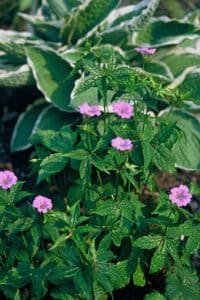
Geraniums (cranesbills) are popular garden plants, but most prefer sun. G. nodosum forms the exception; these varieties thrive in shade. All have a very long flowering period and many even tolerate dry shade. This cultivar has an intense, deep magenta colour that truly stands out. Like every Geranium nodosum it self-seeds, but unwanted seedlings are easy to remove. Highly recommended for beginners!
Hedychium hybrid ‘Tara’
A spectacular ornamental ginger with impressive candle-shaped flowers in a vivid orange colour. I would say: the very best! Lightly scented as well. ‘Tara’ is hardy with a mulch layer and can also be grown in a large pot (overwinter in the greenhouse and feed regularly). In the ground, shoots appear in June. This beauty looks best in large clumps, reaching 1.20–1.80 m tall. ‘Tara’ tolerates light shade and prefers humus-rich, slightly moist soil. Give it a try!
Begonia pedatifida ‘Nervures Rouge’
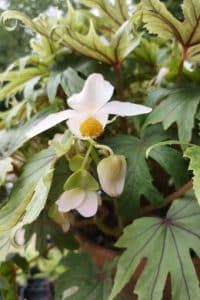
This garden begonia is proven hardy. So why not try it? It has deeply cut, hand-shaped green leaves with red veins. Best in shade, it grows to around 45 cm tall. The pink flowers appear in July or August, but they’re not even necessary for its ornamental value. Choose a moist but well-drained spot; Begonia dislikes waterlogged soil. Beautiful in combination with Brunnera, low ferns or Helleborus.
Disporum longistylum ‘Night Heron’
Disporum resembles Solomon’s seal. ‘Night Heron’ is a beauty. Stems and foliage emerge elegantly in early spring, coloured deep reddish-brown. Combined with the yellow-green flowers, it creates a striking appearance. Older clumps resemble bamboo because of their bracts around the stem segments. In good conditions this Disporum grows over 1 metre tall. It prefers humus-rich, moist yet well-drained soil. In autumn it produces shiny dark berries and the foliage is evergreen. Loved by bumblebees. A personal favourite, but beware of late spring frost.
Maianthemum racemosum
Maianthemum (Smilacina) racemosum may be a mouthful, but it’s an excellent shade plant. This ‘false Solomon’s seal’ is easy to distinguish from the real one by its creamy-white plumes. The flowers have a pleasant scent. Slow to establish, but once settled it forms beautiful arching clumps. A plant for gardeners with patience. After flowering it produces berries that turn from greenish-pink to red.
Woodwardia unigemmata
Among foliage plants, ferns are indispensable. A vast family with huge diversity. One highlight: Woodwardia unigemmata, a chain fern with fronds up to 150 cm. New fronds emerge red, turning bronze before becoming green. It produces bulbils on the fronds, decorative and demonstrating how it propagates. Young plants can be frost-sensitive; older clumps cope well with some winter protection.
Persicaria ‘Dragon’s Eye’
Red-leaved plants add depth to borders. ‘Dragon’s Eye’ is a great, non-spreading Persicaria. It remains lower (100 cm) than the common P. microcephala ‘Red Dragon’, which often flops and needs support. This cultivar features dark red chevron markings with cream margins. It performs well in partial shade but also in sun. The dark foliage combines beautifully with green-leaved plants, especially those that bloom early and fade in summer, keeping the garden lively.
Strobilanthes penstemoides
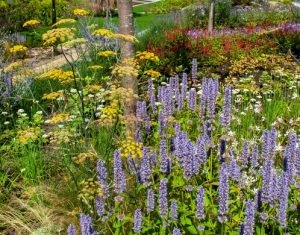
Most gardeners know the coarse S. atropurpureus. But Strobilanthes penstemoides is, in my opinion, the more beautiful relative. It is branched, leafy and very floriferous, producing masses of large blue flowers from July onward. Flowering continues for a long time. Tolerates plenty of shade but also thrives in sun. This species does not spread or self-seed. Among all plants in my garden, this is one of the very best.
Saruma henryi
Still relatively unknown, which is a pity. Beautiful large heart-shaped leaves with a velvety touch. In early spring the foliage is dark purple, fading as the season progresses. The light yellow flowers face outward and appear for months, sometimes until September. Easy-going regarding conditions: partial shade is fine, full sun works with adequate moisture, and they even tolerate dry shade. About 50 cm tall and wide, hardy and lightly self-seeding.
Diphylleia cymosa
Known as ‘Umbrella Leaf’, related to Podophyllum. A shade plant from the Appalachian region with large bronzy young leaves. White flowers appear in May–June and are followed by beautiful blue berries. Attractive three times over.
Trillium species
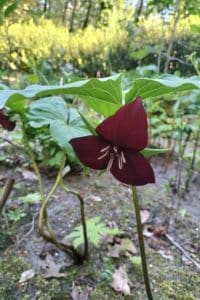
Wonderful woodland plants with a simple appearance. The name refers to the ‘threes’: each stem has three sepals and three petals. Slow-growing and therefore expensive; seed to first flower takes around six years. I have no favourites – they are all beautiful. Two groups exist: species with stalked flowers (e.g. T. erectum or T. flexipes) and species with sessile flowers directly on the leaf, often with mottled foliage. I find the taller species most useful in gardens. Trillium kurabayashii, with large dark-red spring flowers, is a great example.
Ypsilandra thibetica
A little-known plant without a Dutch name. It forms evergreen rosettes and flowers very early: February. White spikes with blue stamens. Even after flowering the plant looks good as the spike turns soft pink. Strongly scented – you’ll need to kneel to smell it. Prefers humus-rich soil. Give it time to settle and protect it from fast-growing neighbours.
Pieter’s gardening tip
Shady spots don’t have to be difficult; they offer wonderful opportunities for different planting and atmosphere. First determine what kind of shade you have. If the spot sometimes receives sun during the warmest part of the day, choose plants that grow in sun or partial shade. If the border still gets no sun around midday, choose plants for partial to full shade. Pay attention to foliage since many shade plants bloom early before the canopy closes. Mix shapes, colours and textures so your garden stays interesting all year. Improve the soil with plenty of organic matter such as compost before planting.