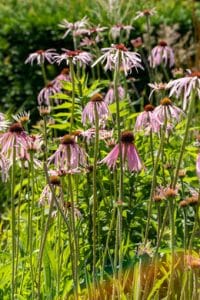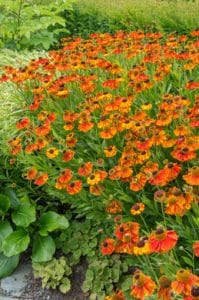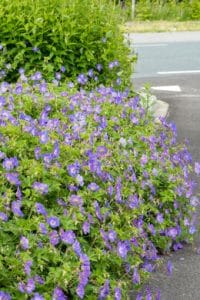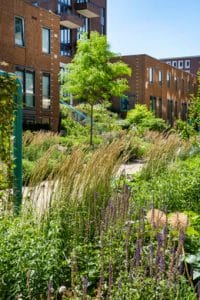
Compared with turf, planting with perennials is economically attractive in the long term. Above all, perennials create an appealing living environment with high biodiversity value. For success, making the right choices in advance in terms of installation, plant assortment and management is essential.
Low‑input maintenance
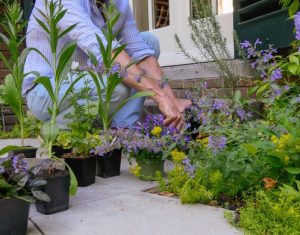
When installing, perennials require a higher initial investment than turf. Thanks to low‑input maintenance, this investment is recovered over time. For a sustainable planting, the key prerequisites are a site‑appropriate plant assortment, professional installation and a management strategy that aligns with the intended visual outcome.
Soil
A free‑draining, fertile and weed‑free soil forms the foundation. In practice, soil improvement is often required, ranging from incorporating organic matter to complete soil replacement. This benefits both soil structure and water‑holding capacity.
Plant assortment
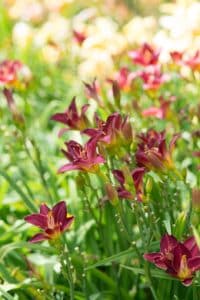
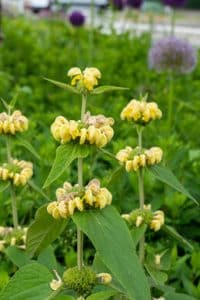
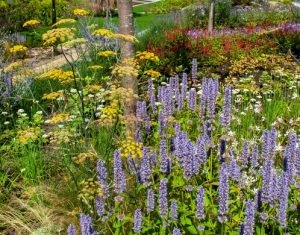
Variation in structure, colour and flowering period creates an attractive streetscape throughout the year. From fresh spring green to the winter silhouettes of plants such as Phlomis (Jerusalem sage). For urban applications, it is essential that the selected assortment can withstand stress factors such as drought, heat, road salt and occasional foot traffic. Many suitable species are available, including Hemerocallis (daylily), which tolerates both road salt and drought well.
Management strategy
The simplest and most effective management strategy is mowing the planting early in spring. This is preferably done from March to early April, when the plants have already produced approximately 10 cm of new growth. The planting is mown mechanically to a height of around 1 cm, just above the growth points.
The young growth points are therefore mown together with the old foliage and the woody stems from the previous flowering season.
The cut material is left in place and functions as mulch. This mulch is rich in nutrients from the previous growing season and contributes to improved moisture retention and a higher organic matter content in the soil. This mowing method stimulates the underground adventitious buds to sprout immediately. The result is rapid, dense regrowth, which reduces weed pressure and rejuvenates the planting annually. As a result, the usual practice of lifting, dividing and replanting after several years is no longer necessary.
Immediately after mowing, an application of organic fertiliser is applied to support regrowth. Once this fertilisation has been depleted after approximately three months, the mulch automatically takes over the nutrient supply.
Further maintenance mainly consists of regular, shallow hoeing with a narrow hoe. During the growing season, this becomes increasingly unnecessary as the planting closes. Shallow hoeing is not harmful: perennials are sufficiently vigorous to recover quickly from minor damage. Moreover, loosening the topsoil layer reduces capillary action, resulting in less evaporation and more moisture remaining available to the roots, a method formerly known as the ‘water ring’.
This management approach does require a suitable plant assortment. Species such as Vinca minor (lesser periwinkle) are less suitable, as hoeing can pull loose the rooted runners. However, there are more than enough alternative ground‑covering perennials available that perform well within this maintenance regime.
Tip
Carry out weed control as much as possible mechanically and at the surface. Regular shallow hoeing keeps the soil aerated, limits evaporation and accelerates plant closure. In this way, weeds are naturally suppressed and the planting remains vital and low‑maintenance over the long term.